PETER FERRARA PART I: THE CASE FOR NEWT GINGRICH

(Also read Peter Ferrara Part II)

Peter Ferrara is one of the most courageous, principled and formidable conservative thinkers of our time. His service to America goes back to early in the Reagan Administration when he was barely out of law school.

He was there in 1993 when the Heritage Foundation offered the “Conservative Alternative” to “Hillarycare.” The Heritage Foundation is the platinum standard for conservative think tanks; I am a proud member. But Heritage and conservative leaders in Congress got this wrong. Their government run “individual mandate” was more onerous than the Hillarycare employer mandate. Ferrara courageously stood by the unpopular truth. His position prevailed but it cost him many relationships among Washington Conservatives.

He was also there in 1990 when President (read my lips, no new taxes) Bush broke his pledge and veered away from Reaganomics. Junior member of the House Minority leadership team, Newt Gingrich, worked to stop the disastrous plan earning him the lasting animus of the Republican Establishment. But it showed Gingrich’s character and courage and earned him Ferrara’s lasting respect. In “The Case for Newt Gingrich,” Ferrara says, “Gingrich’s rebellion against Bush’s 1990 betrayal of Reaganomics was his finest hour.”

Peter Ferrara’s book, America’s Ticking Bankruptcy Bomb, is essential reading for conservatives. If you haven’t, read it, get it done. Now here is Ferrara’s compelling Case for Newt Gingrich in its entirety.

(The American Spectator) He led us to victory before. Spectacular, historic victory. The strategy and content of his 1994 Contract withAmerica propelled the Republicans to a 54-seat gain in 1994 to win control of the House of Representatives, which had been held by the Republicans for only two out of the previous 62 years. Even the Reagan Revolution in the 1980s failed to achieve that.

Then, for all the caterwauling we have heard about how he handled the budget battles withClinton, he led the House Republicans in 1996 to their first re-election as a majority since 1928, almost 70 years.

Moreover, once in power, Gingrich delivered on his promises, and maintained a solid conservative record. He carried out the Contract withAmericain full, holding a vote on every item as promised, most of which did pass (which was not promised). His record was unswervingly pro-life, pro-gun and Second Amendment, and anti-tax. Indeed, he worked closely with the conservative activist groups on every one of these issues.

Gingrich’s Balanced Budget: Succeeding Where Bush Failed
Contrary to the untouched by reality liberal/left talking points about how the 1993 Clinton tax increases led to balanced budgets, when the Gingrich majority took power in 1995, it was greeted by the 1996 Clinton budget still projecting $200 billion annual budget deficits as far as the eye could see, totaling $2.7 trillion over 10 years, confirmed by CBO. The House passed a budget bill providing for $1 trillion in spending cuts over the next 10 years, and that was almost 20 years ago when $1 trillion was still real money.

In the government shutdown budget battles with Clinton, Gingrich won the substance, as Gingrich demonstrated the only way to balance the budget, with Reagan’s supply-side economics. That involved both cutting taxes, to get the economy booming, and cutting spending, resulting in the longest period of federal surpluses since the 1920s.

This is what the official government records show. You can dig deep into the records at omb.gov yourself. Total federal discretionary spending, as well as the subcategory of non-defense discretionary spending, declined from 1995 to 1996 in actual nominal dollars. In constant dollars, adjusted for inflation, the decline was 5.4 percent. By 2000, total federal discretionary spending was still about the same as it was in 1995 in constant dollars. As a percent of GDP, federal discretionary spending was slashed by 17.5 percent in just four years, from 1995 to 1999.

Total federal spending relative to GDP declined from 1995 to 2000 by an astounding 12.5 percent, a reduction in the federal government relative to the economy of about one-eighth in just five short years. This was accomplished not just by reducing discretionary spending, but through fundamental structural reforms of some programs, such as the old AFDC entitlement program. The Gingrich Congress succeeded in block granting that program back to the states, after two vetoes fromClinton. After 10 years, the taxpayers saved 50 percent on the costs of that program, while the poor formerly on the program gained by going to work, with poverty among them plummeting. That is a model for future entitlement reform.

As a result, the $200 billion annual federal deficits, which had prevailed for over 15 years, were transformed into record-breaking surpluses by 1998, peaking at $236 billion by 2000. Over four years, the national debt held by the public was reduced by a record $560 billion in surpluses. When Gingrich left office, instead of CBO projections of $2.7 trillion in deficits over the next 10 years, CBO projected surpluses of $2.3 trillion over the next 10 years. That is a positive turnaround in the budget of $5 trillion. This is exactly what we need today.

These spending cuts were accomplished not with a deal with the Democrats to raise taxes, but with pro-growth cuts in tax rates. Gingrich led enactment of a capital gains tax rate cut of nearly 30 percent in 1997, from 28 percent down to 20 percent, which was the largest capital gains cut in American history. Despite that cut, actual capital gains revenues soared $84 billion higher for 1997 to 2000 than projected before the rate cut. The Republican Congress also expanded IRAs, and adopted other tax cuts on capital.

Contrast that with the disastrous 1990 Bush/Darman/Sununu budget deal, trading permanent tax increases for supposed future spending cuts. The economy dropped into recession almost from the moment the deal was announced, with GDP declining 3.6 percent in the fourth quarter of 1990. That briefly ended the 92 straight months of economic growth of the Reagan recovery, almost 60 percent longer than any other peacetime expansion inU.S.history.

As a result, federal tax revenues declined rather than increased, despite the tax hikes engineered by Bush budget director Richard Darman, intellectually dominated by the Washington Post and New York Times. Federal revenues had been running 18 to 18.4 percent of GDP before the budget deal, but they declined to 17.5 to 17.7 percent during 1991 to 1992. Pulitzer prize winning columnist Paul Gigot of the Wall Street Journal reported in January 1993, in a column entitled “Oops, Weren’t We Going to Reduce the Deficit?” that the rich paid $6.5 billion less in taxes in 1991, after the tax rate hike, than they did in 1990 before rates went up.

While the Joint Tax Committee had estimated the 10 percent luxury tax on boats, airplanes, cars, jewelry and furs would raise $6 billion in 1991, the actual revenue increase was $53,000. The lost revenue from laid off workers previously building luxury boats and planes was far greater. In the first two years of the luxury tax, 9,400 non-rich boat makers lost their jobs.

At the same time, federal spending rose rather than fell, climbing from 21.2 percent of GDP in 1989 to 22.3 percent in 1991 and 22.1 percent in 1992. In 1991 and 1992 federal domestic spending exploded by 20 percent. “Notwithstanding all the budgeters’ talk of pain,” wrote Howard Gleckman of Business Week after the budget deal was consummated, “spending at home is in for a windfall.” Everything from Head Start to NASA to Medicaid to highway spending enjoyed beefy budget increases in this new austere budget environment.

The deficit consequently soared from $152 billion in 1989, to $221 billion in 1990, $269 billion in 1991, and $290 billion in 1992, when the voters rightly booted Bush out for violating the no new taxes pledge that got him elected. As a Cato Institute report concluded: “The 1990 budget deal was not the deal of the century, but the crime of the century. It hurt the economy, reduced revenues, increased spending, and failed its ultimate test: it didn’t reduce the budget deficit.” But to this day,Washingtonbudget experts want another grand bipartisan budget deal just like what happened in 1990.

Ironically, Gingrich is being savaged by the Bush crowd now for his role in leading House Republicans in 1990 to reject the Bush budget deal. Bush White House Chief of Staff John Sununu, Sr. is bitterly attacking Gingrich as unstable for opposing the Bush budget deal circus. Former President Bush has endorsed Romney because he is not “a bomb-thrower,” in Bush’s words, a reference to Gingrich’s refusal to lead House Republicans off the cliff with him.

Gingrich’s rebellion against Bush’s 1990 betrayal of Reaganomics was his finest hour. That leadership is what led to the House Republican takeover in 1994. If conservatives and supply-siders do not rally around Gingrich now, and allow the Bush crowd to win with Romney, Reaganism will have been routed out of the Republican Party. Undoubtedly, John Sununu will pick Romney’s budget director (remember his pick of Supreme Court Justice David Souter over the conservative alternative that would have given conservatives a firm majority on the Court). The first thing Romney will do if elected is exactly the reprise of the 1990 tax increase budget deal for which theWashingtonestablishment that will run a Romney Administration is always pining. That will require another round of Democrats in the White House before conservatives can even get a chance at winning again, whichAmericacannot survive at this point.

Gingrich’s Platform
Besides Gingrich’s proven record of conservative leadership, he is running this year on the most visionary free market platform of any candidate ever.

It is all in writing at Newt.org. Gingrich is campaigning on the ultimate, supply-side, pro-growth, Jobs and Economic Recovery plan of cutting taxes and spending to balance the budget, just as he did in the 1990s. He is proposing the 15 percent optional flat tax plan of Steve Forbes and Steve Moore. He proposes corporate tax reform, closing loopholes in return for lowering the rate to 12.5 percent asIreland did in 1988 to such great success.

He would eliminate the capital gains tax, the death tax, and the alternative minimum tax. He would allow immediate expensing for capital investment, like the deductions for all other business expenses, instead of dragging those deductions out over many years through arbitrary depreciation schedules.

These tax reforms are explicitly not designed to be revenue neutral. They are designed to be growth maximizing, resulting in the most jobs and the most rapidly rising wages and incomes. The professional score of these reforms will be released this week, showing how the budget can be balanced with economic growth and spending cuts. Those would involve returning most budget line items to pre-Obama levels, and then freezing them there until budget balance. It would also involve abolishing all corporate bailouts and corporate welfare, and terminating, breaking up, or privatizing stale, outdated programs, like NPR, the Corporation for Public Broadcasting, AMTRAK, and Fannie Mae and Freddie Mac.

It would include as well the most sweeping, long-term entitlement reforms ever proposed, which are also spelled out in comprehensive detail in writing at Newt.org. He would adopt and then expand an individual choice for personal savings, investment and insurance accounts for younger workers that would be expanded over time to finance all of the benefits financed by the payroll tax, as inChile, ultimately displacing the payroll tax entirely. Gingrich would bring Jose Piñera fromChile to campaign for this idea acrossAmerica, but especially among Hispanics, with the grassroots campaign targeted at younger workers and minorities that George W. Bush should have followed through with, but never did. Such personal accounts involve the biggest reduction in government spending in world history, as all that spending now financed by the personal accounts would ultimately be shifted to the private sector.

Gingrich also proposes to expand his enormously successful 1996 AFDC welfare reforms to the nearly 200 remaining federal means-tested welfare programs, sending all federal welfare back to the states. The projected federal and state spending on these programs over the next 10 years is $10 trillion. Based on the experience with the 1996 reforms, that spending can ultimately be cut in half or more through these reforms.

Gingrich would further slash taxes, spending and regulatory costs by trillions by repealing and replacing Obamacare with Patient Power. Those reforms would provide a health care safety net that would ensure access to essential health care for the uninsured at just a fraction of current costs, with no individual mandate and no employer mandate. You can just ask John Goodman at NCPA about that, who is personally advising Gingrich on health policy. I myself have been an unpaid close personal advisor to Gingrich for years.

Taken together, these entitlement reforms would over the long run cut federal spending in half from what it would be otherwise, completely solving America’s entitlement and fiscal crisis. That estimate reflects my life’s work on entitlement reform and budget policy at the Cato Institute, the Heritage Foundation, NCPA, and now the Heartland Institute. The full discussion can be found in my book published last June by HarperCollins, America‘s Ticking Bankruptcy Bomb.

Posted in 2012, Reclaiming and Restoring America, Remaking the Republicans | Leave a comment

OBAMA PLACES HIMSELF NO LOWER THAN FOURTH AMONG AMERICA’S PRESIDENTS

With some confidence, or more accurately hubris, Obama declared only three presidents got more done in their first two years than he had: LBJ, FDR, and Lincoln. Remember in January 2009, Rush Limbaugh declared, “I hope he fails!” Today Rush agrees with Obama—not about his place in history but in carrying out his agenda to destroy America. “He (Obama) has been wildly successful,” Rush declared. Take a Look at Obama in a Steve Kroft 60 Minutes interview:

But consider a partial list of Obama’s successes:

  • Campaigned as the one to unify America instead only works with (union) friends; treats all other Americans as enemies.
  • Was presented as the healer of racial distrust and division, instead his administration is all race all the time. He and his pals have set back race relations a generation.
  • Has an Attorney General and Justice department that stridently makes law enforcement decisions based on race.
  • Took complete credit for the killing of Osama bin laden while his Justice Department activly seeks to prosecute American agents that made the mission possible.
  • Ignores court decisions and orders.
  • Uses the power of government to punish success.
  • Employs gangster methods to take over American businesses.
  • Uses gangster methods against political opponents.
  • Runs up a first term National debt increase of $6 trillion. (“I’ve got 5 more years,” he declared.) Heaven help us.
  • Takes over and commences the destruction of America’s health care.
  • Cut domestic oil exploration 40% and is personally responsible for skyrocketing energy costs worldwide.
  • Promotes the destruction of the American dollar.
  • Changed America’s foreign policy to “If you are our friend, shame on you. If you are our enemy, shame on us.”
  • Peace negotiations with and apologizes to the Taliban.
  • Recognizes Muslim Brotherhood.
  • Hates and detests Israel and the UK as evidenced by American policy and his statements and conduct.
  • Diminished NATO and allowed Russia to build an alliance from the Atlantic to the Middle East to the Pacific.
  • OBAMA POLICY: QUR’AN DELICATE PIECE OF ART; HOLY BIBLE TRASH

We have our work cut out for us. We must, at any cost, succeed in ridding America and our posterity of this man. We must successfully discredit his agenda.

Posted in 2012, Liberals Deatroying America, Obama, Obama's America: Racism, OWS, Reclaiming and Restoring America | Leave a comment

THIS IS THE FIRST SUNDAY IN LENT—WHAT ARE YOU DOING ABOUT IT?

Six weeks from today the greatest events in all of human history will be celebrated around the world—the death and resurrection of the Savior of the World, Jesus Christ. We are in the period set aside for reflection and recommitment by Christians. It is essential that Christians use this time productively. If you are not on a Lenten program, please start one. To that end, here is a wonderful tutorial on Lent from Jackie Gingrich Cushman published at Townhall.com. Let it inspire your personal commitment to productively prepare yourself for service now.

After Mardi Gras: a Time for Reflection, Reconnection and Humility

Lent began this week on Feb. 22. It ends April 8 with the celebration of Easter. In the Christian tradition, the Lenten period is a time of fasting and prayer, preparation and reflection in anticipation of Easter, which commemorates the death and resurrection of Jesus.

Lent is referred to as a 40-day period, even though the calendar count is 46 days. Sundays are excluded, as each represents a mini-Easter, or a break from the Lenten period. These symbolize the 40 days that Jesus fasted in the desert. During this time, Jesus was tempted by the devil three times and resisted each time.

Historically, Lent has been a time to provide instruction to new converts and young Christians as a way to strengthen their faith, as well as a period for believers to spend in reflection to strengthen their faith.

Traditionally, Lent is a time for people to give up a vice, or to participate in virtuous acts. People often give up sweets, bread, alcohol, meat or other items. Good works include helping others, giving money to those in need or time spent in prayer. Lent allows Christian believers to focus on God rather than the world. Prayer and fasting are a way to change the patterns of their everyday lives to allow time for reflection, introspection and contemplation.

The Tuesday before Lent is Shrove Tuesday or Mardi Gras (French for Fat Tuesday). This is the last day to feast before Lent begins, the last period of excess.

Lent, which is derived from the Old English word lencten, or spring, begins just as winter starts to be oppressive and transitions us into the next season. It’s a time of somberness, seriousness before the joy of spring.

While the Lenten season transitions us into spring, the political primary season transitions the American electorate into the general election. While the primary process is the first hurdle in the race to the national election, it is the general election that ultimately determines who will become our country’s next president.

The primary process allows the parties, and the candidates, to hone their message, to ensure it is on target, is clear and well articulated, before the inevitable onslaught of the general election.

Lent reminds each of us that we are to be humble. That, instead of focusing on ourselves, we should focus on God and on how we can serve others.

This humbling is in opposition to the state of hubris, exaggerated pride or self confidence, all too often prevalent in our society.

Hubris has been evident throughout this election cycle, especially among pundits who proved to be consistently incorrect in their predictions regarding who was going to win which primary or caucus. Pundits who often appear to believe their prognostications are more important than the issues and the voices and votes of the American people.

It would be more helpful to the process if instead of focusing on the tactics or horse race of the primary process, that those who have the ability to amplify a message would instead provide information on issues for the American people to focus on and work through. In the end, the American people will decide, through their action or inaction, who will lead our nation.

Perhaps the presidential candidates will be reminded of this call to humility this Lenten season, remembering that the campaign — in the end — is not about them, their campaign staffs or their advisors, but about the American people.

Let us also be humbled and reminded of our responsibility as citizens in our great nation. A democracy is only as effective as its citizens are active. Our job is to think through the issues, relying not on pundits’ statements and campaign slogans, but on our understanding of each candidate’s experience platform and policies.

This is hard work, not for the weak nor weary. But work that is worthwhile.

Let this period of Lent be one of introspection and reflection, allowing you to determine what is important to you, preparing you to take action to make it happen.

Rest, reflect and be humbled. Lent will soon be over. The activities of spring and the general election will soon be upon us. Make sure you are prepared to fully participate.

Posted in Uncategorized, World Events | Leave a comment

GINGRICH TO OBAMA: STOP APOLOGIZING FOR AMERICA AND DEMAND RESPECT!

Update: Two more Americans were murdered today Inside the Afghanistan Interior Ministry building!

NY Times

“This one sided street which is typical of the Obama Administration of going around the world apologizing for America and never demanding respect; these are troops serving under the Commander in Chief and he owes them some protection.”  

President Barack Obama embarrassed America again Thursday when he apologized to Afghan President Hamid Karzai for the burning of Qurans by NATO troops. In a letter delivered by U.S. ambassador to Afghanistan Ryan Crocker, Obama called the act “inadvertent” and “an error,” saying, “We will take the appropriate steps to avoid any recurrence, including holding accountable those responsible.”

But it was reported that those Qurans had been used as vehicles to smuggle information out by detainees and were therefore “considered desecrated.” It was understood the proper way to dispose of “desecrated Qurans” is by burning.

Speaker Gingrich represented every American patriot in Washington State Friday morning with a sharp reaction to the President’s shameful conduct and Friday evening on Fox News’ Greta Van Susteren and his appearance here  with Piers Morgan at CNN.

Posted in 2012, Jinad/Shariah, Liberals Deatroying America, Liberty, Obama | Leave a comment

TWO MEN; TWO KINDS OF LEADERS; TWO VISIONS FOR AMERICA

The two men are Speaker Gingrich and President Obama

The leadership difference is apparent in their vision of America and Energy. Here is a review of the Obama Energy record, a breathtaking Gingrich proposal and, in immediate response, an Obama pout.

As you know, America has by far the largest oil, gas and coal reserves in the World. You may also know President Obama has slowed America’s already slow fossil fuel development 40% over the past 3 years. But the President’s new energy direction swung into action in early 2009 as his Import-Export bank made a $2 billion loan commitment to the Brazilian National oil company, Petrobras. Petrobras also obtained a $10 billion loan from China’s Development Bank with a commitment to sell China 200,000 barrels/day for 10 years. (Coincidentally billionaire George Soros owns millions of shares in Petrobras.)

By last spring, Obama was pretty excited about his energy program and America’s energy future. He said, in part, “We want to help you with the technology and support to develop these oil reserves safely. And when you’re ready to start selling, we want to be one of your best customers. At a time when we’ve been reminded how easily instability in other parts of the world can affect the price of oil, the United States could not be happier with the potential for a new, stable source of energy.”

The Gingrich plan is rooted in his response to a sharp spike in gas prices for several months in 2008: “Drill Here; Drill Now; Pay Less.” The Gingrich plan (vision) is the subject of a new video released Wednesday evening. The half hour video will be shown on television in several primary/caucus States through Super Tuesday. This video will change your outlook. You will be inspired for America.

President Obama immediately struck back at this vision for America. His press secretary, Jay Carney, said sadly Thursday that we cannot drill our way out of the problem and we will have to accept the pain. The President also sprung into action with the firm belief Americans are ignorant, here’s what he said:

Get involved here.

Get involved here

Update (2.25.2012) Asked Friday by CNN and Fox News his reaction to the Presidents defense of a bleak painful energy future for America, Speaker Gingrich said it sounded like a SNL skit.

Posted in 2012, Drill Here Drill now, Liberty, Obama | Leave a comment

“NEWTIE AND THE BEAUTY,” SAYS DENNIS MILLER— SIGNIFICANT ENDORSEMENT #10 FOR NEWT GINGRICH—A MAN FOR OUR TIME

Radio talk show host, comedian and raconteur, Dennis Miller says, “Newtie and the Beauty” should be the ticket to defeat Obama and reclaim America. “Newt is the smartest guy in the room and I don’t think Barak Obama wants a piece of that guy in a debate . . . I want Sarah Palin [the Beauty for Vice President] because too many people I don’t respect hate her.” Take a look:

Y ou can join Dennis—contribute to Newt here now.

Posted in 2012, Reclaiming and Restoring America, Remaking the Republicans | Leave a comment

BULLYING IN OAKLAND CALIFORNIA SCHOOLS IS BEING FIRMLY DISPACHED WITH A CURRICULUM ON “GENDER DIVERSITY”

It is 65 years since the Supreme Court of the United States of America handed down, in Everson v. Board of Education, the ruling that local public school districts could not provide services to parochial schools. The court based its decision on the equal protection clause of the 14th Amendment. This was not much of a stretch to get federal power involved in local government. The stretch was claiming the First Amendment somehow declared a “wall of separation between church and state.” Addressing religion, here is what the First Amendment actually says, “Congress shall make no law respecting the establishment of religion or prohibiting the free exercise thereof.”

Complying with the “wall of separation” demand required a change of mindset for public school boards towards parochial schools from cooperative to, as it turned out, antagonistic. More than that, a “wall of separation” led to the view that the “wall of separation” was not between church and state but instead between God and government. By 1960, lawsuits were working through the courts demanding enforcement of the “wall of separation” provision. In 1962 the Supreme Court heard Engle v. Vitale on school prayer and then in 1963, broadening the prohibition against prayer in school, the Court handed down Arlington School District v. Schempp. But this decision also outlawed reading the bible in school. Here are the two decisions in summary:

Engle v. Vitale: “Because of the prohibition of the First Amendment against the enactment of any law “respecting an establishment of religion,” which is made applicable to the States by the Fourteenth Amendment, state officials may not compose an official state prayer and require that it be recited in the public schools of the State at the beginning of each school day — even if the prayer is denominationally neutral and pupils who wish to do so may remain silent or be excused from the room while the prayer is being recited. Pp. 422-436.”

Abington School District v. Schempp: Because of the prohibition of the First Amendment against the enactment by Congress of any law “respecting an establishment of religion,” which is made applicable to the States by the Fourteenth Amendment, no state law or school board may require that passages from the Bible be read or that the Lord’s Prayer be recited in the public schools of a State at the beginning of each school day — even if individual students may be excused from attending or participating in such exercises upon written request of their parents. Pp. 205-227.

Some pay more attention than others, but we all know how far we slid down that 75 year slippery slope. For example, now the Oakland (CA) school district, as an anti-bullying measure, is (started last year) installing a “Gender Diversity” program, beginning in kindergarten, teaching that sexual identity is a multiple choice spectrum available to all. It seems there is chronic bulling in schools in the 21st Century that seems to require lessons in sensitivity towards homosexuals. Let us note that in 1947 and 1963 bullying was never an issue. Schools in 1947 (when I was an elementary pupil) and 1962 (when I was a high school teacher) had God (His presence) but didn’t have government, didn’t have bullying and didn’t see diversity as an American principle. The 21st Century schools are an organic part of the government and God has been barred for nearly three generations. Now, we have bullying problems and gender diversity solutions instituted that may have landed an administrator in treatment for the insane in 1947. Learn the story at Oakland here.

It seems clear a fundamental task ahead is to get God back into the learning experience and get government out. Check out my post tomorrow on that.

Posted in Defending Christianity, Liberals Deatroying America, Reclaiming and Restoring America | Leave a comment

SELF APPOINTED JESSE JACKSON ATTEMPTS TO TUTOR US ON THE PROPER USE OF THE FINGER

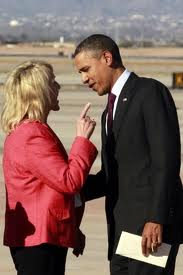
Governor Brewer met Air Force I, when it landed in Arizona last week, to greet President Obama. She cordially greeted him and offered him a letter. He initially declined and sternly reprimanded her for recounting, in her book, Scorpions for breakfast, the treatment she received at the White House last year. “I don’t appreciate it,” the President fussed. Governor Brewer defended her description of the meeting as an accurate accounting. Actually, as you can see, she passionately defended her book.

News accounts predicted angry blowback over this “affront.” But somebody needed to come forward and take on a leadership role. Jesse Jackson was rested and ready. “Do you know how insulting it is to put your finger in somebody’s face?” Jackson charged. “Try it with the cameras rolling — she knew the cameras. She knew what she was doing. She was telling him off. She was cutting him down to his size. She must never get away with that.”

“Even George Wallace did not put his finger in Dr. King’s face,” he said, referring to the segregationist former governor of Alabama.

But Jackson is no expert in the use of the finger (Mrs. Clinton is). This is a little tutorial starting with Governor Brewer (above) who effectively used her finger to equalize the disadvantage shorter people have. This is a representative sample of President Obama’s finger techniques for Republicans and America’s friends.

Unlike the President, Jesse Jackson seems to have a different approach than the finger. In early July, 2008, Jackson was set for an interview at the Fox Television Chicago Studio. Here’s what he said to another guest, “I want to cut his [Barack Obama’s] nuts out” and he accused his fellow Chicagoan of “talking down to black folks” by giving moral lectures to African-Americans.”

Clearly the President’s finger would take him further with the more direct “I’m comin’ at ya” approach demonstrated perfectly here by Mrs. Clinton.

Posted in Irony Is Funny, Obama's America: Racism | Leave a comment

VIN WEBER ON NEWT GINGRICH—“ONE OF MY CLOSEST FRIENDS AND HE WOULD MAKE A GREAT PRESIDENT”—A MAN FOR OUR TIME

Why is Vin Weber a member of the economic policy committee for Mitt Romney’s presidential campaign? That is the question.                  

But first, who is Vin Weber? Vin Weber was probably the most conservative person elected to Congress from Minnesota in the past 80 years until Michele Bachmann entered the 110th Congress in 2007. Weber served six terms from 1981 to 1993. When Weber left Congress, although he was by far the most influential and powerful Minnesota Republican, he stayed in Washington. Today Mr. Weber serves as the managing partner in Washington of the lobbying firm, Clark & Weinstock.

After his reelection in 1982, Weber joined with fellow Reagan conservative, GA congressman, Newt Gingrich to form the Conservative Opportunity Society (Gingrich’s idea). Their purpose was to transform the Republican party into an effective conservative governing vehicle for the challenges of the 21st Century on the horizon. Their approach was to think of the Republican party as the majority governing party—something it had not been since 1933. Here is Weber’s description looking back thirteen years from the mid 90’s:

The most important thing is to understand then, as now, that twelve, thirteen year ago [1983], Newt Gingrich understood and argued that the Republican Party could not simply be against. They had to replace what existed with something new. For a long time, nobody paid much attention to it. Or they might have laughed at it, called us the Conservative Opportunists Society, things like that. But it was a tremendously important notion. He thought it through and we discussed it. Words were chosen fairly carefully even before the program was fully developed.

In fact, the program is not fully developed today. But his notion was that what we had in this country can be called a Liberal Welfare State. People think of that as a term of denigration. That wasn’t always a term of denigration. If you describe something as a Liberal Welfare State, thirty or forty years ago people would have been proud to say that’s exactly what we’re trying to build here. It contrasts with an authoritarian state. It contrasts with the Darwinian free enterprise, laissez-faire. Liberal Welfare State was a positive idea.

It’s a sign of the times how much that has become pejorative. His argument was that we need to talk about replacing the Liberal Welfare State with something. It’s going to be, number one, conservative, based on conservative principles, rather than liberal principles, of free markets, individual freedom, decentralization—a whole range of ideas that are conservative in opposition to what we have come to think of in twentieth century America as Liberal.

[It’s] opportunity as opposed to welfare; welfare being, in our view, synonymous with a dependency society. What we talked about doing was replacing that with a society that would actually give people opportunities to become independent. Society, as opposed to state, recognizing that the dominant form of our culture is not governmental and that the most important centers of activity in society, if you will, are families, non-profit organizations and neighborhoods. The grand ascent of the state has been an abnormality, a move away from the norm. Granted, for all of us, it’s dominated our lifetimes. But that doesn’t mean that it has dominated the history of this country or much of the world. We’re going to get, in some ways, back to and ahead of this period when we were dominated by a Liberal Welfare State. So, the Conservative Opportunity Society was a fairly carefully thought-out construct. I argue, even today as we’re sitting here, the main challenge to the Republican Party and the conservative movement is to think through what replaces welfare state policies as opposed to simply editing them, defunding them and tearing them down.

Some things can probably be abolished and never be missed. The public expects government to respond to a lot of different problems like education, poverty, problems of the inner city and [to] figure out exactly how to approach those. It remains our major challenge. You can really say that the one person who’s been saying for a long time, fifteen years or more, that that’s what we had to be thinking about was Newt Gingrich.

I think that military analogies are pretty helpful in understanding Newt Gingrich. He wasn’t a military person himself but he grew up in a military family. [He] studied a lot of military history and has studied the military both as a partial vocation and as a serious avocation. I don’t know if he still does [1996], but he always used to lecture at the War College. He thought of it as one of his most interesting volunteer assignments. He occasionally went on the maneuvers with the Navy to see what they’re doing. Figuring out how that affects his thinking is important. And he certainly thinks of himself as a general. There’s no question about that.

In terms of the strategy that we employed, I think one of the most helpful things to think about is that he had a construct and we really developed it. We needed to develop as a party – wedge issues and magnet issues. It’s a fairly simple notion with wedge issues, or ideas that really separated the Democratic majority from the public, issues where they were plainly wrong and the public did not support them. But they were, for a variety of reasons, not paying a political price. In those cases our assignment was to find ways of making clear the differences between the Democratic Party and the public on those issues driving a wedge between the Democrats and their constituencies.

The Balanced Budget constitutional amendment was one of those. Voluntary school prayer was another. With both of those issues, seventy to eighty per cent of the public said they were in favor of the constitutional amendments. Democrats not only opposed them but used their power in the Congress to prevent them from coming for vote. For a long, long time there were no votes on either of those constitutional amendments. So that’s exactly the sort of thing we were arguing. If they could be forced to make those positions clearly known to their voters, they’d pay a political price. There’s a whole range of issues like that.

The magnet issues really relate to this concept of a Conservative Opportunity Society—always understanding that you can’t just win by being negative. Ultimately there has to be a positive set of issues that attract people to the Republican Party, issues for which they feel confident voting for. That part of the message was lost early on because the press and our opposition, of course, only focused on confrontational tactics that we employed in the House, tactics that deserved a lot of attention. But it did obscure for many years people’s vision when it came to understanding what Newt Gingrich was all about. They laughed at the notion that there even was a positive side to this movement. In fact, it really was much more than simply bashing the Democrats on a few key issues. I think people now understand that. For many years people in [our] own party didn’t really understand that.

[Pennsylvania Congressman] Bob Walker, who was probably the third member of COS, was really the person who was most in tune with C Span and argued the strongest that it needed to be a fundamental part of our constituency.

It’s important in a second way to understand that part of Gingrich’s strategy, and all of our strategy, was to understand that while we created a faction within the Congress, we could multiply its strength beyond its numbers if we also did something outside of the Congress to create a faction, if you will, in the country.

There are a number of things we did then. One of them was to form the Conservative Opportunity Society group outside of the Congress. We met every Wednesday [at] noon at Paul Weyrich’s offices at the Free Congress Foundation. It consisted mainly of conservative activists, sort of a cross-spectrum of issues from the Washington area to become the troops outside of the Congress supporting what we were doing inside of the Congress. Paul is a really important figure in all of that. The ‘inside/outside operation,’ I believe, was his invention. It was the notion that if you wanted to succeed inside the Congress, if you’re in the minority party, you needed an outside operation of activists and organizations to support you and lobby the Congress and write on your behalf.

Their principle tool was the Special Orders.

C Span really fit into that in a very big way. It was a potential to expand the ‘outside operation’ in ways that nobody had thought about. We understood that however many people were in the chamber of Congress, there were always a lot of people watching C Span. I don’t know what the current ratings are. But I remember one prominent Republican in the Congress who was pretty sympathetic to us. [He] would never engage in special orders, for instance, at the end of the day, when the formal business of Congress is over because he said there was nobody there watching. Bob Walker said to him, ‘You’re wrong, there’s half a million people watching.’ Because at that time, that was the best ratings we had showed, that at any given time you only have about half a million people.

I remember Newt Gingrich argued to Jack Kemp, ‘If you could be guaranteed that you could have an audience of half a million people in a stadium listen to you, you’d never turn down a speaking engagement.’ But because you can’t actually see them in front of you, they’re home in their offices and living rooms watching, there’s a sense that you’re not talking to anybody.

We found out, real quickly, that they were out there. Wherever Bob or I or Newt or Duncan Hunter went, we shortly found out that there were all sorts of C Span junkies, if you will, that watched us, that identified with COS, that paid attention to what we were saying, and that were ready to contact their Congress people. We found a lot of the senior members who were not part of COS, maybe some who were quite hostile to see us, would find themselves going home, speaking to a Republican audience and afterwards, a number of their own constituents and supporters would come up and say, ‘Isn’t it great what those guys on COS are doing. I hope you’re helping out Newt and Vin and Bob.’ So the reach of C Span was tremendously important in that way.

Weber’s reflections on Newt in 1996 after Newt Gingrich was speaker and he, Weber, was out of Congress

I like him. I liked him then; I like him now. I think he’s a guy with a good sense of humor who likes to have a good time. We’d go to movies and restaurants together and we enjoyed each other’s company, I’d say. He is however, a workaholic. I guess that probably has some technical meaning and psychological jargon and I’m not trying to engage in any armchair analysis. I just mean when people ask me about his success, I say there’s a lot that’s unique there. Some of it’s not very hard to explain. Number one, he is very smart. I’m not saying he’s smarter than anybody in the Congress, but he’s a very smart guy. [He has] a high IQ, Ph.D in history, all that stuff. Second of all, he really probably works harder than anyone in the Congress. If you’re smarter than most people and work harder than just about everybody else, it’s hard for you to fail. A lot of that explains Newt Gingrich.

When everybody else is done working at the end of the day and would like some leisure time, time with their family, Newt Gingrich is ready for another round of meetings to clarify the issue that didn’t get clarified at the three o’clock meeting. If you get done at ten o’clock and still haven’t driven it home finally, he’ll say, ‘I’m going to go for a walk tomorrow morning at six-thirty. Why don’t you join me and we’ll talk about this some more?’ And he means it and he’ll be there.

We’re friends and we socialize together. But it’s hard to form a close personal attachment to somebody who is really consumed by his work. I’m sure that his wife Marianne, who’s also a very good friend of mine, finds that frustrating too because nothing really comes before his work.

Would Speaker Gingrich make a good President?

I think he would. I think he’d be a very good President. He has a sense of history. He has an understanding of the issues and he’s shown himself, both as House Republican [Whip] and now as the Speaker of the House, to be able to manage and construct a system that operates efficiently. He’s not just rhetorical. He’s not just philosophical. He’s also highly practical. I think he’d make a great President, actually.

Nearly 15 years later, November 12, 2010, Weber introduced Gingrich at the U.S. GLOBAL LEADERSHIP COALITION with these recommendations:

Thank you. Wonderful. Thanks very much, John. Thank you very much. Great to be with you this morning. I am here for two reasons: one is my tremendous respect and friendship for Speaker Gingrich, and the other is because I’ve learned over my 12 years in Congress that when Ester Kurz asks me to do something, I just saluted it and did it.

But it’s a true pleasure to be here to introduce the speaker this morning. I was elected to Congress in 1980 – sorry, 1981, 1982. Speaker Gingrich had been elected two years earlier. And I was thinking about the traditional introduction I could give to him. There are so many things to say about Newt Gingrich that’s appropriate to this topic and this audience. He does have a Ph.D. in European history. He is the most frequent lecturer to the senior military officers and has been for over 25 years. He’s, in a sense, trained much of our upper-military command.

He did authorize the Hart-Rudman Commission, one of the most important commissions looking at our national security structure in recent years. He is the author of 22 books. All that is very important, but I want to talk about Newt Gingrich a little bit more personally for a second, if I can, because I can remember the first day that he and I began working together – the very first day.

And it was – in my first term in Congress we didn’t really know each other personally very well. We kept finding, in Republican conferences, that we were coming down on the same sides of different issues, saying more or less the same things.

There was a lame-duck session after that election in 1982. And the last day of the lame-duck session of 1982, I remember standing in the well of the House, and this guy who I knew but didn’t really know came up to me. And Newt’s exact words to me were: “What are you doing for the next 10 years?” (Chuckles.) Word for word. And I thought about it, I said, “I don’t know, I guess I’m hanging around here.” (Chuckles.)

But that was the beginning of an effort to pull together a group of members of Congress that did a lot of things together. And in the popular reading of it, Newt Gingrich led the Republicans to take back the House of Representatives, after 40 years, in the 1994 election. And that’s, of course, true. But that was not the primary objective.

Newt Gingrich’s primary objective was to transform the Republican Party into a modern instrument that could positively lead America in a time of profound change that he saw coming and very few others did. I remember an analogy that Professor Gingrich used for us at Congress. He said, America, for decades, has been like a boat on a very still lake. And we’re about to enter a white-water river. This was in the 1980s. When I think about what has happened to our country over the last 20 or 30 years – how prescient that was.

I truly believe that other than Ronald Reagan, nobody in my lifetime has done more to help transform the Republican Party and the U.S. House of Representatives into an effective vehicle for leading America in a very dangerous time. And those times are not getting less dangerous, they are getting more dangerous. So it’s a tremendous pleasure for me to introduce to you one of our country’s most important leaders, and one of my closest friends, Speaker Newt Gingrich. (Applause.)

Again, the question is, “Why is Vin Weber a member of the economic policy committee for Mitt Romney’s presidential campaign?”

1996: “I think he’d make a great President.”

2010: “I truly believe that other than Ronald Reagan, nobody in my lifetime has done more to help transform the Republican Party and the U.S. House of Representatives into an effective vehicle for leading America in a very dangerous time. And those times are not getting less dangerous, they are getting more dangerous. So it’s a tremendous pleasure for me to introduce to you one of our country’s most important leaders, and one of my closest friends, Speaker Newt Gingrich.”

Working for Romney????

Posted in 2012, Remaking the Republicans, The Cost of Democrats | 1 Comment

SARAH PALIN: “SHAKE UP THE GOOD OLD BOY NETWORK, VOTE NEWT” —A MAN FOR OUR TIME

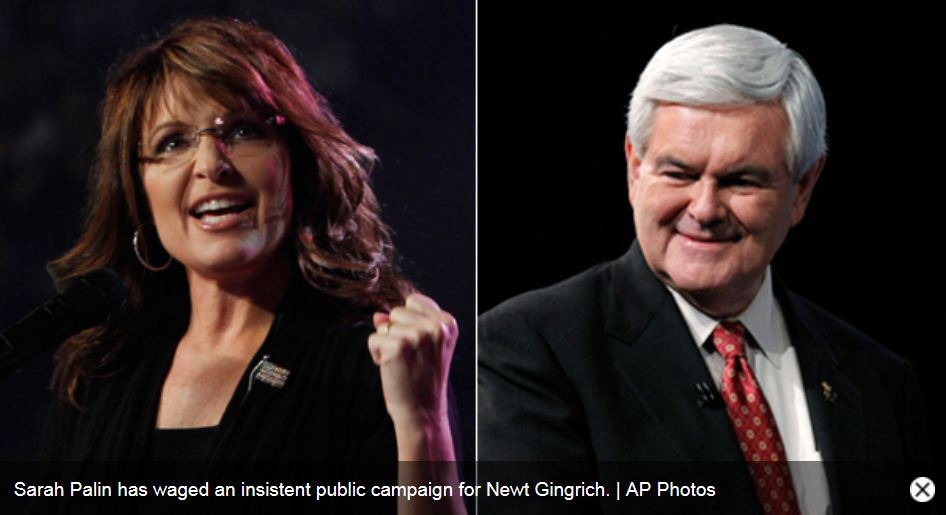
Palin has been active the past week countering false MSM stories about Gingrich as a guest on TV and on her Facebook page. She declares it is crucial to have an extended vetting process. The leftist internet “news site,” POLITICO, running this graphic, dubbed Sarah Palin, “Newt Gingrich’s secret weapon.”

“Vote for Newt [in Florida]. Annoy a Liberal,” is better than an endorsement albeit three days late for maximum impact. She said this and plenty more on Fox News channel Saturday night with Judge Jeanine Shapiro. This complete 10 minute segment is must watching. Take a look.

Among the top reasons to have a lengthy process is primary voters in four States should not choose the candidate to Oppose Obama. Another is Palin’s point that we must have a complete vetting of the candidates. A perfect example is Blood Money, a video showing Medicare fraud of $hundreds of millions committed by a Bain Capital company in the 1990’s while Romney was on the company’s BOD. This video needs to be seen over the next two months. Millions should see it.

Do not doubt me on this, Sarah Palin is engaged in this process. She is and will be a force in the outcome. She knows this election is the last chance to save America as a beacon of Liberty for the world. She has come to know Newt Gingrich is a MAN FOR OUR TIME. Friday, her Facebook had this post:

Cannibals in GOP Establishment Employ Tactics of the Left

We have witnessed something very disturbing this week. The Republican establishment which fought Ronald Reagan in the 1970s and which continues to fight the grassroots Tea Party movement today has adopted the tactics of the left in using the media and the politics of personal destruction to attack an opponent.

We will look back on this week and realize that something changed. I have given numerous interviews wherein I espoused the benefits of thorough vetting during aggressive contested primary elections, but this week’s tactics aren’t what I meant. Those who claim allegiance to Ronald Reagan’s 11th Commandment should stop and think about where we are today. Ronald Reagan and Barry Goldwater, the fathers of the modern conservative movement, would be ashamed of us in this primary. Let me make clear that I have no problem with the routine rough and tumble of a heated campaign. As I said at the first Tea Party convention two years ago, I am in favor of contested primaries and healthy, pointed debate. They help focus candidates and the electorate. I have fought in tough and heated contested primaries myself. But what we have seen in Florida this week is beyond the pale. It was unprecedented in GOP primaries. I’ve seen it before – heck, I lived it before – but not in a GOP primary race.

I am sadly too familiar with these tactics because they were used against the GOP ticket in 2008. The left seeks to single someone out and destroy his or her record and reputation and family using the media as a channel to dump handpicked and half-baked campaign opposition research on the public. The difference in 2008 was that I was largely unknown to the American public, so they had no way of differentiating between the lies and the truth. All of it came at them at once as “facts” about me. But Newt Gingrich is known to us – both the good and the bad.

We know that Newt fought in the trenches during the Reagan Revolution. As Rush Limbaugh pointed out, Newt was among a handful of Republican Congressman who would regularly take to the House floor to defend Reagan at a time when conservatives didn’t have Fox News or talk radio or conservative blogs to give any balance to the liberal mainstream media. Newt actually came at Reagan’s administration “from the right” to remind Americans that freer markets and tougher national defense would win our future. But this week a few handpicked and selectively edited comments which Newt made during his 40-year career were used to claim that Newt was somehow anti-Reagan and isn’t conservative enough to go against the accepted moderate in the primary race. (I know, it makes no sense, and the GOP establishment hopes you won’t stop and think about this nonsense. Mark Levin and others have shown the ridiculousness of this.) To add insult to injury, this “anti-Reagan” claim was made by a candidate who admitted to not even supporting or voting for Reagan. He actually was against the Reagan movement, donated to liberal candidates, and said he didn’t want to go back to the Reagan days. You can’t change history. We know that Newt Gingrich brought the Reagan Revolution into the 1990s. We know it because none other than Nancy Reagan herself announced this when she presented Newt with an award, telling us, “The dramatic movement of 1995 is an outgrowth of a much earlier crusade that goes back half a century. Barry Goldwater handed the torch to Ronnie, and in turn Ronnie turned that torch over to Newt and the Republican members of Congress to keep that dream alive.” As Rush and others pointed out, if Nancy Reagan had ever thought that Newt was in any way an opponent of her beloved husband, she would never have even appeared on a stage with him, let alone presented him with an award and said such kind things about him. Nor would Reagan’s son, Michael Reagan, have chosen to endorse Newt in this primary race. There are no two greater keepers of the Reagan legacy than Nancy and Michael Reagan. What we saw with this ridiculous opposition dump on Newt was nothing short of Stalin-esque rewriting of history. It was Alinsky tactics at their worst.

But this whole thing isn’t really about Newt Gingrich vs. Mitt Romney. It is about the GOP establishment vs. the Tea Party grassroots and independent Americans . . . read the rest.

Posted in 2012, Reclaiming and Restoring America, Remaking the Republicans | 1 Comment